
Support Indigenous Artisans with Every Purchase and donation.

Living condition

Improvements in living conditions
Recent Improvements
In general, living conditions have improved in the last decade. Many houses are connected to electricity and most of them also have running water. Lack of good drinking water was a major problem in these upper regions. In 2004 a program started to built water reservoirs. Engineers installed wells and water pipes.

Pots for the dyeing process
Self Determination
The annual fee of 32 Bolivianos is a kind of social fund, the members of each production unit (PU) decides themselves how to use the money. The idea at the beginning was a budget for maintaining the weaving workshop on the villages In many PU are workshops, with are often not used anymore, facing problems of maintenance cost, like repairing the machines, light, and so on. Also many weavers prefer to work at home. They normally have kids and their household, working outside just seems not convenient. After a time the women decided that they want to use the annual fee different, to buy things they really need, like in the case of the community Potolo, to buy dyeing pots or new blankets, others decided to participate on a program of an other NGO, which sponsored reading glasses for the poor. Some members decided to use "their money" for the cost of the physician examination.

Potato field

Dry soil
Agriculture
Most farmers in the Jalq’a region grow either tubers such as potatoes, or cereals such as maize or wheat, with every family also keeping a small farmyard of animals for their own consumption. However, with small fields situated on high and step hills, the Jalq'a suffer from both strong soil erosion, and a lack of crop rotation. Many of the tools used for farming in the region use technology dating for the pre-Columbian era, whilst others date from the colonial period, with both types relying solely upon manual or animal labour. With agriculture the major source of income for the area, the majority of food grown is used for the families own consumption, or exchanged for different food with their neighbors. With only the little left sold at market, consequently it is estimated that around 95% of the region can be considered below the poverty level. Many families resort to part time work, such as bricklaying or household chores - however, with such harsh conditions, rural migration is an ever threatening problem, as young people choose to move to nearby cities rather than attempt to earn a living from the land.
Development work

Weavers (Region Yampara)

The house of a weaver
A Different Path to Development
By economic and quantitative definition, two-thirds of humanity were rated as poor, underdeveloped, of the third world and therefore in need of intervention. Today, thanks to being defined as a "developing country," Bolivia receives millions of dollars in international investment, which arrives each year to help finance the main development projects in Bolivia. The amount of international investment is high, but it is not clear how much actually reaches the families in need of the aid and despite growing investment, there is no visible impact of the results. The projects in action often face problems of sustainability once funding is withdrawn by the foreign investors. South Andean, the region of the Altiplano (high plateau) is the poorest of Bolivia. The anthropologists Gabriel Martinez, Veronica Cereceda and Ramiro Molina began an investigation into this region of Chuquisaca. In 1987 they created the Foundation for Anthropological Research and the Ethno (ethnic or ethnics "Anthropologists of the South Andean," ASUR). The Association of Indigenous Art Inca Pallay was created in 2000 as a pilot project by ASUR with the idea of self-management and self-sustainability of the project Art-Textile-Tarabuco Jalq'a. Two years after its founding, ASUR and Inca Pallay became separate institutions.
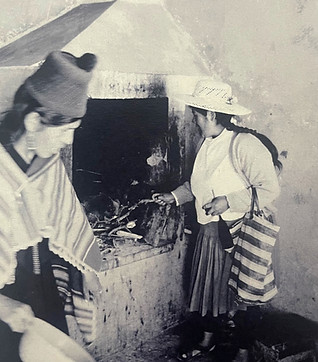
Normally the people cook on the floor
The problems with development work
Development institutions often face the problem of sustainability of their projects. Once the support is cut off for projects, most projects are gradually cancelled, because the support was just coming from outside and weren't working with the people and their needs. One example is foreign NGOs that are endowed farmers in building materials and put them in counterpart labor for the construction of new kitchens with concrete floors and stoves with a smoke inhalation. "The families I visited don't use new stoves; the cement floors are much colder and before the fire stove used to heat up the room. Also the new stoves' height isn't familiar to them, as they are used to sitting on the floor while cooking (...)."
Where they work
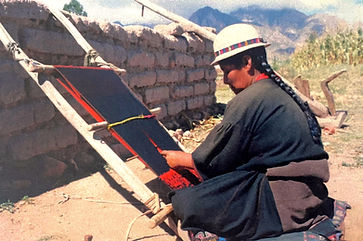
Jalq'a woman weaving outside the house
The majority of textile production and weaving undertaken by the women from Yampara and Jalq'a is performed in their own homes.
Weaving will be fitted in to the timetables of the women and girls around their necessary daily tasks, such as cooking, cleaning, taking the younger children to school, and helping in the fields during the harvest.
Consequently, the weavers are unable to know exactly how many hours they have devoted to any one weaving; however, a large pallay of superior quality, as are displayed in this museum, will generally take around three months to complete. This flexibility allows the weavers, both male and female, to earn an additional income whilst still continuing with their necessary everyday domestic and agricultural chores.

The zig-zag shape is a sign for snake = Pachamama (Mother Earth)
Their houses
-
DOORS (THE ENTRANCE) "When I took the pictures of the countryside, I noticed that often the doors where covered with political quotes. The people in the countryside are very politically minded. Often they belong to political institutions. Whether it is in form of a social organization, as Inca Pallay, a farmer organizations, or others (...) "
-
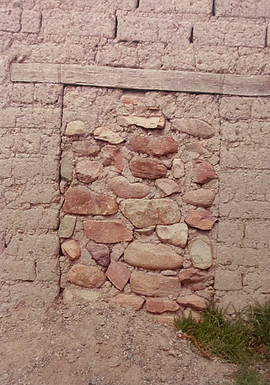
WINDOWS (THE EYES OF THE HOME) "Windows were often closed up with bricks or other materials. The people are only indoors when it rains or at night, so there is no necessity for windows. The rooms just get colder at night, also to build a window with glass costs a lot of money."


Fair trade

Damiana Gonzales & Freddy Vagas

The administrative of Inca Palla
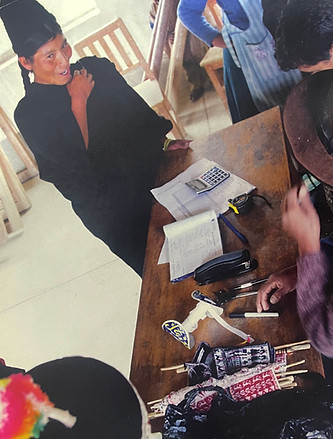
Weavers calculating prices according to quality rating
Breaking the Cycle of Unfair Trade
Inca Pallay created a help for indigenous people living in rural areas of extreme poverty. Encouraging and promoting the preservation, presentation and enhancement of the cultural identity of the Jalq'a and Tarabuco communities, as well as to improve the economic conditions and by this, the way of life for its artisans.
In the past, textiles were sold only when there was a lack of money, to pay for medical consultations, legal issues, or food due to poor harvests.
For the weavers and artisans it is very complicated to commercialize their products. One option is directly on the Sunday market in Tarabuco or cities of Bolivia, but even this is very complicated because of its agricultural occupiers, constant transport costs, accommodation, food insecurity and the missing knowledge of the market.
Under these circumstances they are forced to sell their textiles to middlemen who buy textiles at bargain prices, then resell to tourists or souvenir shops at higher prices.
A Fair and Inclusive Association
Inca Pallay exists only for the benefit of artisans and craftsmen who make up the association and its leaders. For this reason, Inca Pallay also created a social fund that helps each member become more stable financially.There is no distinction or discrimination on grounds of religious belief, age, ethnicity, gender, political affiliation or any other area in the association.
Reviving Tradition, Preserving Dignity
One other important aspect is the recovery of lost designs that women no longer know how to knit/weave. With the help of a photographic archive and a guide the women began imitating the fabrics, and soon started making their own creations. The new pieces gradually became more complex, even with new techniques. In this sense, the 'Textile Art Project' presents the production of textiles not only as a means of generating income in impoverished regions, but also as a way to "the dignity of their own culture." Working to promote and conserve the cultural traditions and identity expressed through indigenous art, Inca Pallay allows the wider world to experience and appreciate the artistic skills of its weavers and artisans.
Qualities and payment
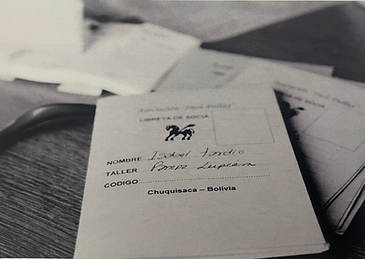
Member ID
There are 4 different qualities in the tissues Axsu, Saka, and Sakita Tapize.
Payment is by cm2 and quality:
-
First quality = SE (SuperExtra) = 0.16 Bs
-
Second = EE (ExtraExtra) = 0.15 Bs
-
Third = E = 0.14 Bs
-
Fourth = A = 0.13 Bs
Example :
Axsu measures 100cm × 50cm = 5000cm2
with the quality SE = 800 Bs
wages + yarn = 5000 x 0.11 = 550 Bs
Minus the contribution for the PU* 800 х 0.1 = 80 Bs
Payout = 1270 Bs
*PU: production unit
Payment is made upon delivery of the fabric, with a small deduction for the work of their PU 1% of wages.