Support Indigenous Artisans with Every Purchase and donation.

Symbols in Jalq'a Weaving
The world of the " ukhu pacha" and the Jalq'a pallay, is thought to be ruled by a figure called both the Saxra, and the Supay. In its most figurative aspect the Supay is a deity, sharing both aspects of the Christian Devil (due to the Hispanic influence), and also of the Gods of the underworld and solitary places, as found in other parts of the Andes. Present in almost every asxu, he is said to be the master and ruler of the khuru world. Almost always shown as a masculine figure, he is both the opposite and enemy of the feminine "Pacha Mama", god of new life and harvests. Represented as a horned and winged figure either with real wings or arms in the shape of wings, and often carving a walling cich despite his importance the Supay is often only a small figure compared to the khurus - you might even be able to see a couple in the same asxu. In the past, when mining was more profitable and therefore widespread, miners would always leave an offering of coca leaves, tobacco and chica before entering the mine; it was believed that the Supay must be appeased thus, before entering his subterranean world, to avoid angering him and incurring bad luck.

Unreal or nonexistent
Of the unreal or non-existent khurus, the most commonly woven is the jorobado, or "hunchback," a creature distinguished by a triangular shaped bump which protrudes from its head and also appears in the middle of its back. This animal also has a curved tail and often has its mouth wide open bearing its teeth (sometimes with a large tongue jutting out) as if roaring or barking. It is similar, though different, to the equally fantastical griffin, a winged two or four-legged and slightly smaller khuru, that / has a spiral-shaped tail that folds in on itself to form a circle. Sometimes shown with an elongated back, it most commonly has an equally spiral-shaped tongue, similar to that of the lorobado. However, though the jorobado and griffin are the more fantastical of the khurus, even the representations of 'real' animals are often rendered surreal. The weavers often use extra lines used to break the contours of the fiour tail and often has its mouth wide open bearing its teeth (sometimes with a large tongue jutting out) as if roaring or bark-ing. It is similar, though different, to the equally fantastical griffin, a winged two or four-legged and slightly smaller khuru, that has a spiral-shaped tail that folds in on itself to form a circle. Sometimes shown with an elongated back, it most commonly has an equally spiral-shaped tongue, similar to that of the Jorobado. However, though the jorobado and griffin are the more fantastical of the khurus, even the representations of 'real' animals are often rendered surreal. The weavers often use extra lines used to break the contours of the figures, confusing their outline, or showing both eyes even when the head is ostensibly in profile.
Realistic Figures
The condor, a majestic bird of prey found in Bolivia, is both the country's national bird, and is thought to signify strength and liberty.
In the Jalq'a weavings it is typically shown to be attacking and devouring smaller birds with its accentuated long neck that curves in on itself. The smaller birds that surround the condor (and that populate all Jalq'a axsus) are not necessarily deformed or fantastic, they rather have an effect of filling up space, increasing the feeling of chaos and disorder.
Similarly depicted as a 'normal' figure is the monkey, most commonly woven in a curved position to further emphasize flexibility and agility, and with a markedly blackened face.
Just as condors are found all over Bolivia, the monkeys are from the Bolivian lowlands and its jungle world. Monkeys are also often represented in Jalq'a dances, as a humorous being whom jokingly molests and teases the festival goers.


Khurus and their children
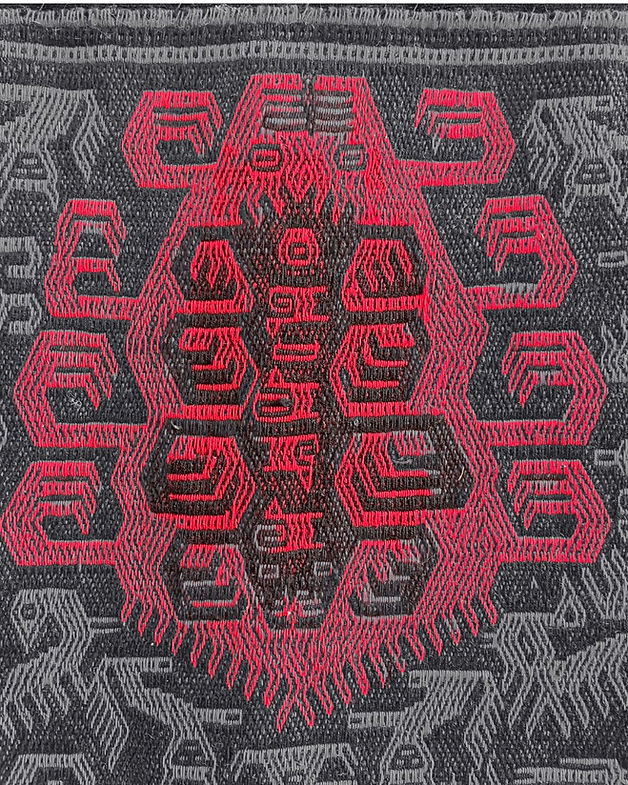
Figures that appear inside or within other ones are said to be the offspring (uñas) of the Khuru, as the Jalq'a believe that in this underworld the animals are perpetually reproducing "wawa" (children).
There is no distinction between male or female, as such categories do not exist; instead, just as the Khurus appear free from the constraints of gravity, so are they divorced from concept of conventional biology, with the spicies of the "wawa", or child, rarely corresponding to that of the parent. A mammal can be pregnant with a snake, a bird with two wildcats, a horse with a dog, with this twisting, overlapping profusion of Khurus and their wawa constantly confusing the eye. Consequently, it is never quite clear where one Khuru ends and the other begins, whether one is looking at the background or the figure itself. It is this confusion of constant reproduction that is on of the most prized attributes of a Jalq'a pallay, described as the weavers as "chaxusqa kanan tian" - "it must be disordered".
Human Beings
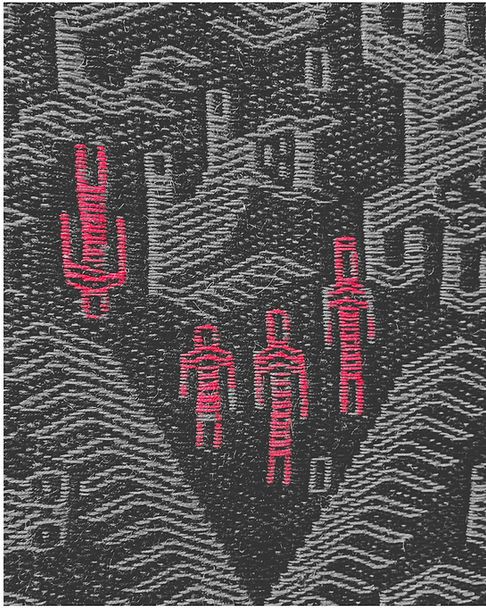
Human beings rarely appear in this predominantly non-human world governed by khurus.
When they are shown it is always simplified, as figures reduced in size and maintaining frozen static-like positions, appearing lost amidst the movement and confusion of the larger, more detailed and horrific figures that surround them. Humans rarely wear distinguishable clothes that define their ethnicity or belonging - instead, they remain anonymous objects, appearing out of place and seemingly unable to wield any power as to the direction of their fall or the positions they have been placed in. As in a fantastical nightmare, humans are also sometimes depicted riding lla-mas, which in reality is unable to bear more than 30kg, on which they appear to be born along without any control.