
Support Indigenous Artisans with Every Purchase and donation.

From raw wool to living tradition
How the Textiles are made
Every weaving is more than a piece of fabric — it’s a story that takes two to three months to complete. Each step, from the shearing of the sheep to the final knot, is done by hand following ancestral techniques that have been passed down for generations.

Raw material
The weavers buy the raw material from Inca Pallay. When they sell their products a plus is paid for the work of twisting and dyeing. This system was introduced so that the weavers do not waste resources.
Yarn (sheep's wool)
-
For the precision work of the fabrics an industrial spinned yarn is used. The advantage of the industrial yarn is the consistent quality, it does not warp and all weavers are working with the same basic material. Inca Pallay buys yarn form a factory with a loose twist. The weavers twist yarn afterwards on hand spindles to the desired rotation. Often they need more twist or sometimes a double thread.
Acrylic yarn (synthetic)
-
Is used for commodities such as Place-mats, bags, key chains, etc., and often for ponchos (Tarabuco).
-
Don't absorb much water!
Shearing & Spinning
The primary part of the weaving process is with the shearing of the sheep, an event that normally occurs in spring-time, and is carried out manually using a sharp knife.
The gathered wool will be used for all types of weaving and household tex-tiles, with families selling the excess wool at market. The raw wool firstly needs to be spun however, to obtain a strong, yet fine and even thread which can then be used for textiles.
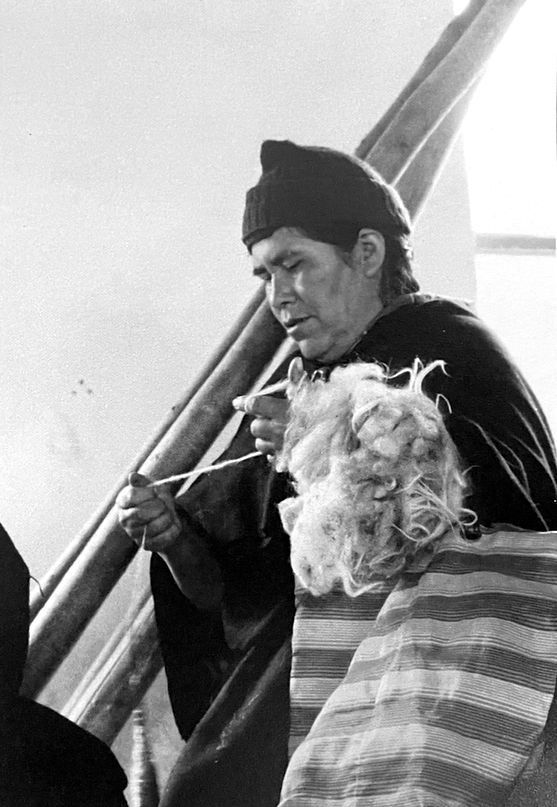
To spin the wool, the unwashed wool is wound around one of the spinner's wrists. Using both hands, the spinner will then tease the wool slowly to the desired thickness, whilst spinning the wooden spindle (or "phusqa") in a circle, to gather the thread.
Once all the wool has been spun once, wool from two different spindles are then combined and doubled, using a third spindle to spin the two separate threads into one single, thicker thread. This thread is then wound around the spinner's hand is then wound around the spinner's hand and elbow, to form a skein, ready for washing.


Washing & Dying
The skein of wool is washed with soap or ashes in warm water, to both clean the wool of any dirt, and to strip it of its natural grease, leaving it ready to be dyed.
The skeins are dyed in saucepans full of boiling water, which are tinted the desired color, as well as containing various fixing agents, such as lemon. In the saucepan, the skein is constantly agitated, only removed and dried when it has absorbed the desired amount of dye.
Traditionally, wool is dyed with a range of natural ingredients, such as mud, sulphur, insects (cochineal), leaves and flowers; how-ever, due to their comparative cheapness, and reliability, chemical tints are used more and more frequently. Dyed skeins are classified as being one of four tones, or "guises" - g'illu (red to yellow tones), parti (purple and blue tones), d'umir (green tones) and pink.
Of course, the Yampara will use all the tones, whilst the Jalq'a generally only require black and red for their pallays.
Weaving
For the technique practiced by the women, firstly the weavers must prepare a frame (or„loom") with a net of wool, called the warp in English, or "saya" in Quechua.
In the case of the Jalq'a, red and black wool will be wrapped around the loom, one red thread for every black, whilst for the Tarabuqueños, the white cotton is accompanied with the rainbow of different colored wool which forms the recognizable "stripy" pattern.
It is only after the loom has been fully threaded, that the weaver will then separate the two different colors, placing a long, thin stick high up on the loom called the "illawa", to keep one color beneath, while the other rests above.
During weaving, the weaver will pass a small, sharp stick along the loom, drawing a string along, called the weft, from one side to the other. By choosing which color thread from the warp to place in front of this weft, the weaver forms the design of the pallay.
To ensure a high quality and dense design, after every weft has been passed from one side to the other the weaver will strike it down firmly to tighten the weave, using a tool made from an animal bone.
